
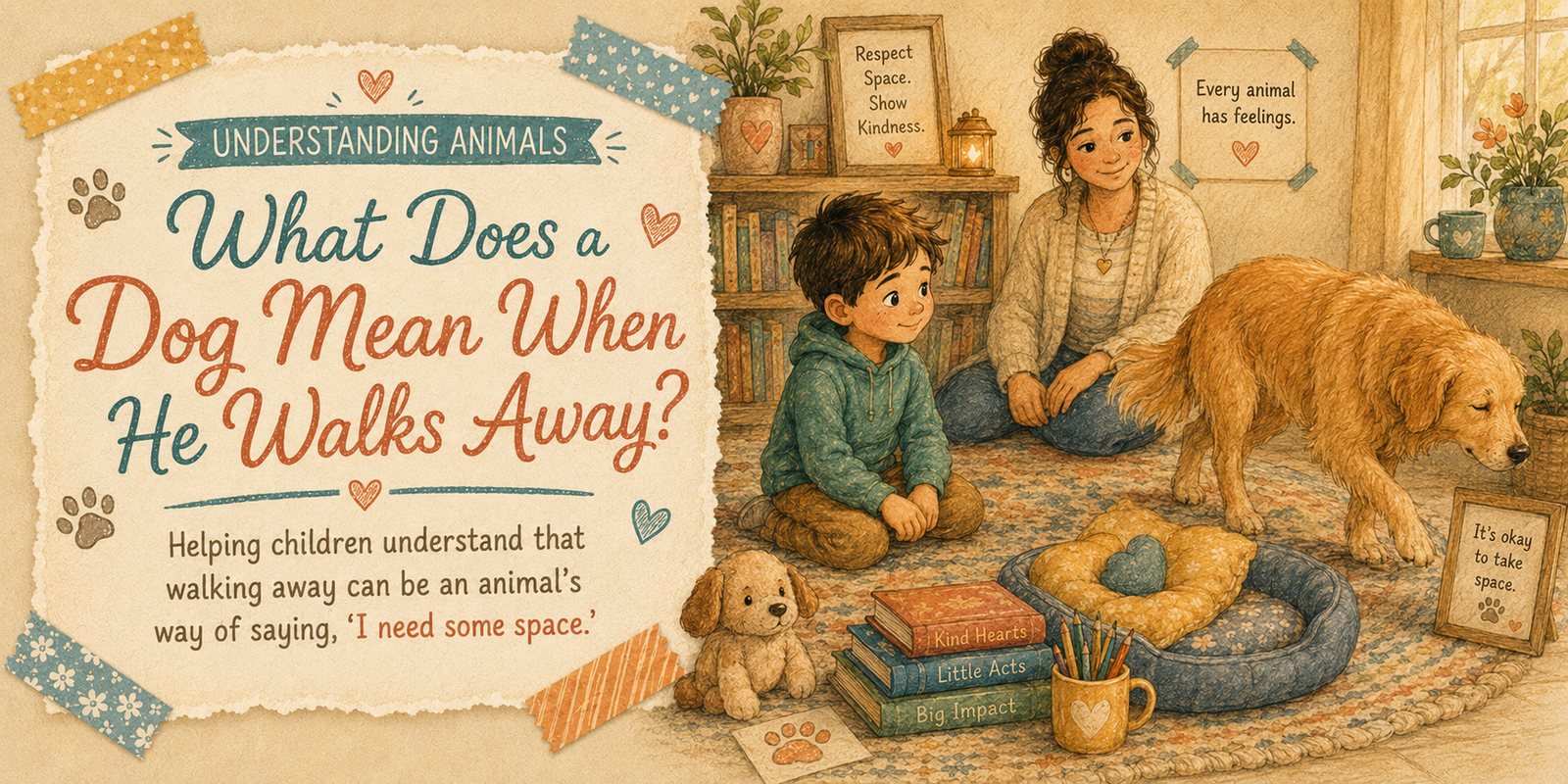
Children often show affection by moving closer.
They want to pet the dog again, sit beside him, hug him, follow him into another room, or keep playing because they are having fun.
So when a dog gets up and walks away, a young child may naturally think:
“He wants me to follow him!”
Sometimes he might.
But sometimes walking away means something much simpler:
“I’m finished for now.”
Learning to notice that choice is an important part of teaching children to be kind to animals.
Walking Away Is Communication
Dogs cannot tell us with words that they would like a break.
Instead, they communicate through their bodies and behavior.
A dog may turn his head away, shift his body, get up, move to another part of the room, go to his bed, or settle somewhere quieter.
When a dog chooses to leave an interaction, we can teach children that his movement matters.
We do not have to chase him to find out whether he really meant it.
We can simply let him go.
A useful phrase for young children is:
“He walked away, so we’ll give him some space.”
That turns an ordinary moment into a simple lesson about respect.
Why Children Often Follow
A child who follows a dog is usually not trying to bother him.
The child may simply be excited.
Maybe they were playing together.
Maybe the child was petting him and wants to continue.
Maybe the dog is the child’s best friend and following him feels completely natural.
That is why it helps to teach children what to do instead, rather than only saying:
“Stop chasing the dog.”
Try:
“He chose to walk away. Let’s let him decide whether he wants to come back.”
Now the child has a clear alternative: wait.
Let the Dog Come Back
Waiting teaches something powerful.
It teaches children that affection does not have to be forced.
If the dog wants more attention, he may return.
He might walk back over, sit nearby, lean closer, bring a toy, or otherwise choose to interact again.
And if he does not come back?
That is okay too.
The goal is not to teach children how to convince an animal to stay.
The goal is to teach them that the animal gets a choice.
Give Dogs a Place Where They Can Rest
It can help for a family dog to have a quiet resting place that children understand belongs to him.
That might be:
- a dog bed
- a crate used as a comfortable resting space
- a blanket in a quiet corner
- a favorite spot beside a piece of furniture
- another calm area the family has chosen for rest
Children can learn a simple household rule:
“When he goes to his quiet place, we let him rest.”
That does not mean children should be afraid of the dog.
It simply gives the dog a predictable way to leave an interaction.
Don’t Trap the Exit
Another useful lesson is to help children notice whether the dog can easily leave.
If a child is sitting in a doorway, wrapping both arms around a dog, backing him into a corner, or surrounding him with toys and people, the dog may not have a comfortable way out.
We can teach children to leave open space.
You might say:
“Make sure he has room to walk away if he wants to.”
This is especially helpful when children are playing on the floor, where it can be easy to accidentally block a pet’s path.
Look at the Whole Dog
Walking away is one piece of communication, but children should not be taught to interpret a dog based on one signal alone.
A wagging tail, for example, does not automatically mean:
“Pet me.”
A dog’s body, face, movement, surroundings, and situation all matter.
Adults can help children notice simple things without asking them to become tiny dog-behavior experts.
You might say:
“Let’s look at what his whole body is doing.”
Does he seem loose and comfortable?
Is he moving toward us or away from us?
Is he trying to settle somewhere?
Is he busy eating, sleeping, or chewing?
Is he choosing to stay nearby?
The most important lesson for a young child is not memorizing a complicated list of signals.
It is learning to notice before acting.
What If the Dog Keeps Moving Away?
If a dog repeatedly moves away from a child, do not make the dog keep participating.
The adult should step in.
Give the animal space and redirect the child to another activity.
You might say:
“He keeps choosing more space, so we’re going to let him have it.”
Then offer the child something else to do.
That might be coloring, building, reading, playing with toys, or helping with another age-appropriate activity.
The child learns that respecting the dog does not mean the fun is over. It just means the activity changes.
What About Growling?
A growl should never be treated as something a child needs to investigate.
If a dog growls, an adult should calmly create space between the child and dog and determine what may be happening.
Children should not be asked to approach again to see whether the dog “really means it.”
They also should not be encouraged to punish, scold, hug, or comfort a growling dog themselves.
A child-friendly explanation can be:
“A growl means we need to give him more space. A grown-up will handle it.”
If you have concerns about a dog’s behavior around children, seek help from an appropriate qualified veterinarian or animal-behavior professional.
Try the “Pause, Notice, Choose” Habit
At Kind Hands Books, we like a simple three-part habit:
Pause
Before following, touching, hugging, or reaching, stop for a moment.
Notice
What is the animal doing?
Is he staying nearby?
Is he walking away?
Is he resting?
Is he busy with something?
Choose Kindness
What choice gives the animal comfort and freedom?
Sometimes that choice is petting gently.
Sometimes it is waiting.
And sometimes it is simply letting the dog walk away.
A Small Choice That Teaches Something Big
A dog walking across the room may seem like a very small moment.
But it gives us an opportunity to teach children something much larger.
Love does not mean an animal has to stay beside us.
Kindness does not mean getting all the hugs, pets, and playtime we want.
Sometimes kindness looks like watching a dog walk away and saying:
“Okay. You can have your space.”
Then we wait.
Maybe he comes back.
Maybe he curls up for a nap.
Either way, we have shown the child that the animal’s choice matters too.
Pause. Notice. Choose kindness. ♥ 🐾
