
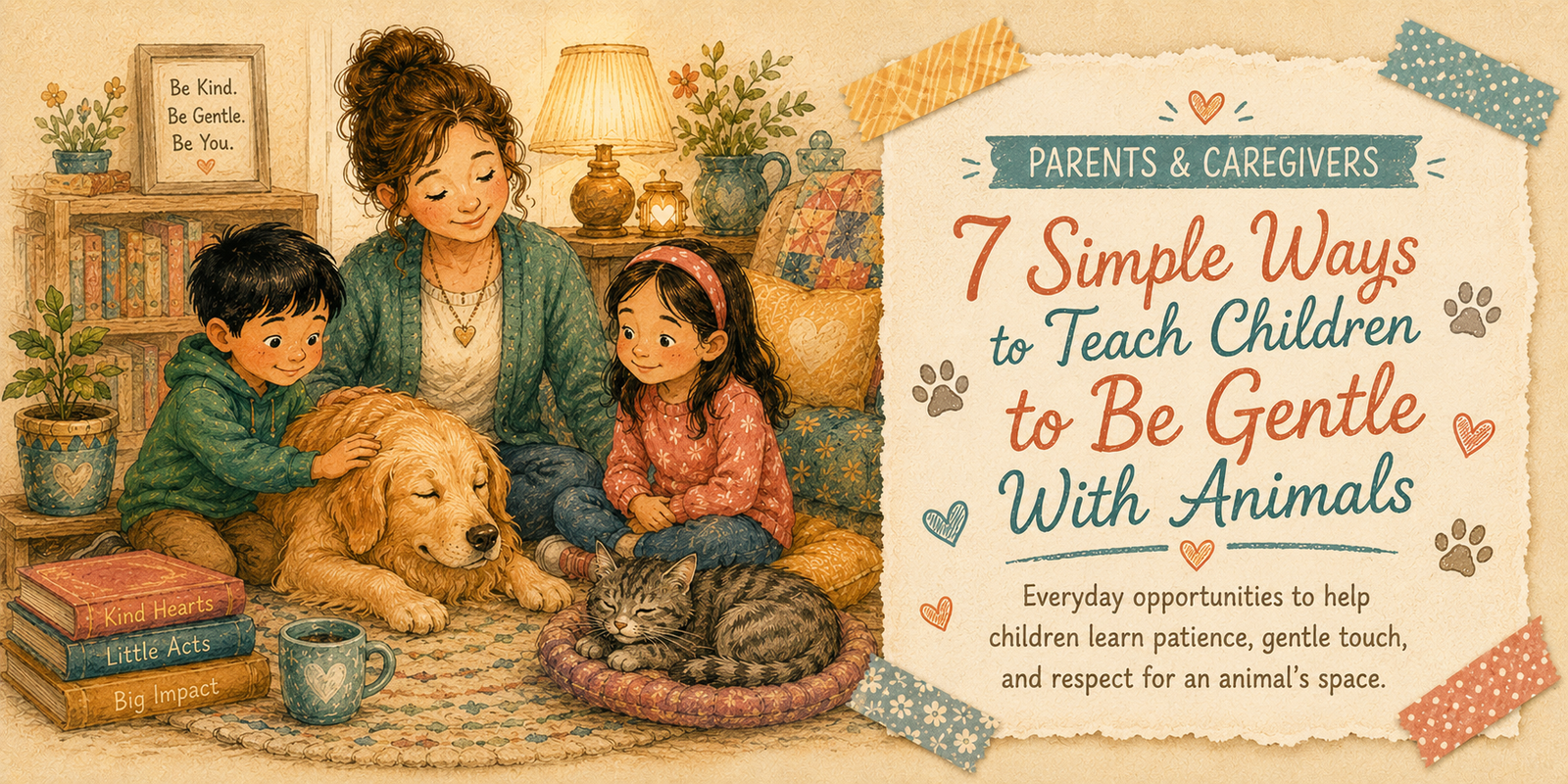
Children and animals can form wonderful friendships. A dog waiting beside the bed in the morning, a cat curling up nearby during story time, or a child proudly helping fill a pet’s water bowl can become some of childhood’s sweetest memories.
But loving animals does not automatically mean a child knows how to behave around them.
Young children are still learning how hard to touch, when to stop, what different animal behaviors mean, and why a pet may not want attention at a particular moment.
That is where grown-ups can help.
Teaching children to be gentle with animals does not have to feel like a long list of rules. Some of the best lessons happen during ordinary moments at home.
1. Teach That Gentle Hands Sometimes Mean No Hands
When we tell children to use “gentle hands,” they may think that means they are always allowed to pet an animal as long as they pet softly.
But sometimes the gentlest choice is not touching at all.
If a dog is sleeping, a cat has tucked herself into a quiet hiding place, or an animal has moved away, we can help children understand that leaving the animal alone is also a form of kindness.
You might say:
“He looks like he wants to rest right now. Let’s give him some space.”
This helps a child learn that kindness is not only about how we touch animals. It is also about knowing when not to touch them.
2. Let the Animal Have a Choice
Children are naturally excited about animals. They may want to run over, hug, pet, pick up, or follow a pet immediately.
Instead, teach children that animals can have choices too.
Try inviting the child to sit nearby and wait.
If the animal chooses to come closer, wonderful.
If the animal stays where he is or walks away, that choice is okay too.
A simple phrase children can learn is:
“Let him come to you.”
Waiting can be difficult for young children, but it is one of the most useful animal-kindness skills they can practice.
3. Help Children Notice When an Animal Moves Away
Walking away is communication.
If a child pets a dog and the dog gets up and leaves, the kind response is not to follow him from room to room trying to continue.
Instead, point out what happened.
“Otis walked away. I think he is finished being petted for now.”
Children can learn that they do not need to make an animal stay.
This is also a good opportunity to teach that we should look at the whole animal and the situation, rather than relying on one body part such as a wagging tail to tell us everything the animal is feeling.
4. Protect Mealtime, Sleep, and Quiet Spaces
Certain times are especially good for practicing respectful boundaries.
Teach children not to bother an animal who is:
- eating or drinking
- sleeping
- chewing a special toy or treat
- hiding or resting in a quiet place
- trying to move away
- showing that he wants space
Instead of simply saying, “Don’t bother the dog,” explain why.
You might say:
“That is his chew. We can let him enjoy it without reaching for it.”
or:
“She is sleeping. We can be kind by letting her rest.”
That gives children a positive action to take instead of only telling them what they cannot do.
5. Show Children What Gentle Petting Actually Looks Like
“Be gentle” can be surprisingly vague to a young child.
Show them.
Using a stuffed animal first can be helpful. Demonstrate a slow, soft stroke rather than patting, grabbing, squeezing, pulling fur, or wrapping arms around the animal.
When appropriate for the particular pet, children can learn to use an open hand and make a few calm strokes on an area the animal is comfortable having touched.
Then stop.
That pause matters.
The goal is not to teach children how to get as much petting time as possible. It is to help them notice whether the animal appears comfortable continuing.
6. Give Children Kind Jobs to Do
Children often want to participate in caring for animals.
Give them safe, age-appropriate ways to help.
Depending on the child, animal, and level of adult supervision, that might include:
- helping refill a water bowl
- putting pet supplies away
- helping prepare a comfortable resting area
- choosing a toy for supervised play
- helping gather clean pet blankets
- drawing a picture of the family pet
- reminding other family members to give a resting animal some space
These little responsibilities teach children that loving an animal includes caring for what the animal needs, not only playing with the animal.
7. Praise the Kind Choice You Want to See Again
Sometimes the most useful teaching moment happens when a child gets it right.
Maybe your child wanted to pet the sleeping dog but stopped.
Maybe the cat walked away and your child did not chase her.
Maybe your child noticed the dog chewing his toy and chose something else to do.
Notice it.
You might say:
“You saw that she wanted some space and you let her walk away. That was kind.”
Or:
“You really wanted to pet him, but you waited because he was sleeping. That was a thoughtful choice.”
Specific praise helps children understand exactly what they did well.
Kindness Grows Through Practice
Children are still learning.
They will forget sometimes. They may become excited. They may reach before thinking or need the same reminder many times.
That is okay.
The goal is not to make children afraid of animals or worried about making a mistake.
The goal is to help them develop a habit:
Pause. Notice. Choose kindness.
Before touching, following, picking up, hugging, or taking something from an animal, a child can slowly learn to stop and ask:
What is the animal doing?
Does the animal seem comfortable?
Can the animal move away if he wants to?
What would be the kind choice right now?
Those are small questions, but they can teach something much bigger.
Animals are not toys that have to participate whenever we want them to.
They are living beings with preferences, feelings, needs, and boundaries of their own.
And sometimes one of the kindest things a child can do is simply sit nearby, keep those little hands to themselves, and let an animal choose what happens next.
Small hands. Kind choices. Happier animals. ♥ 🐾
