
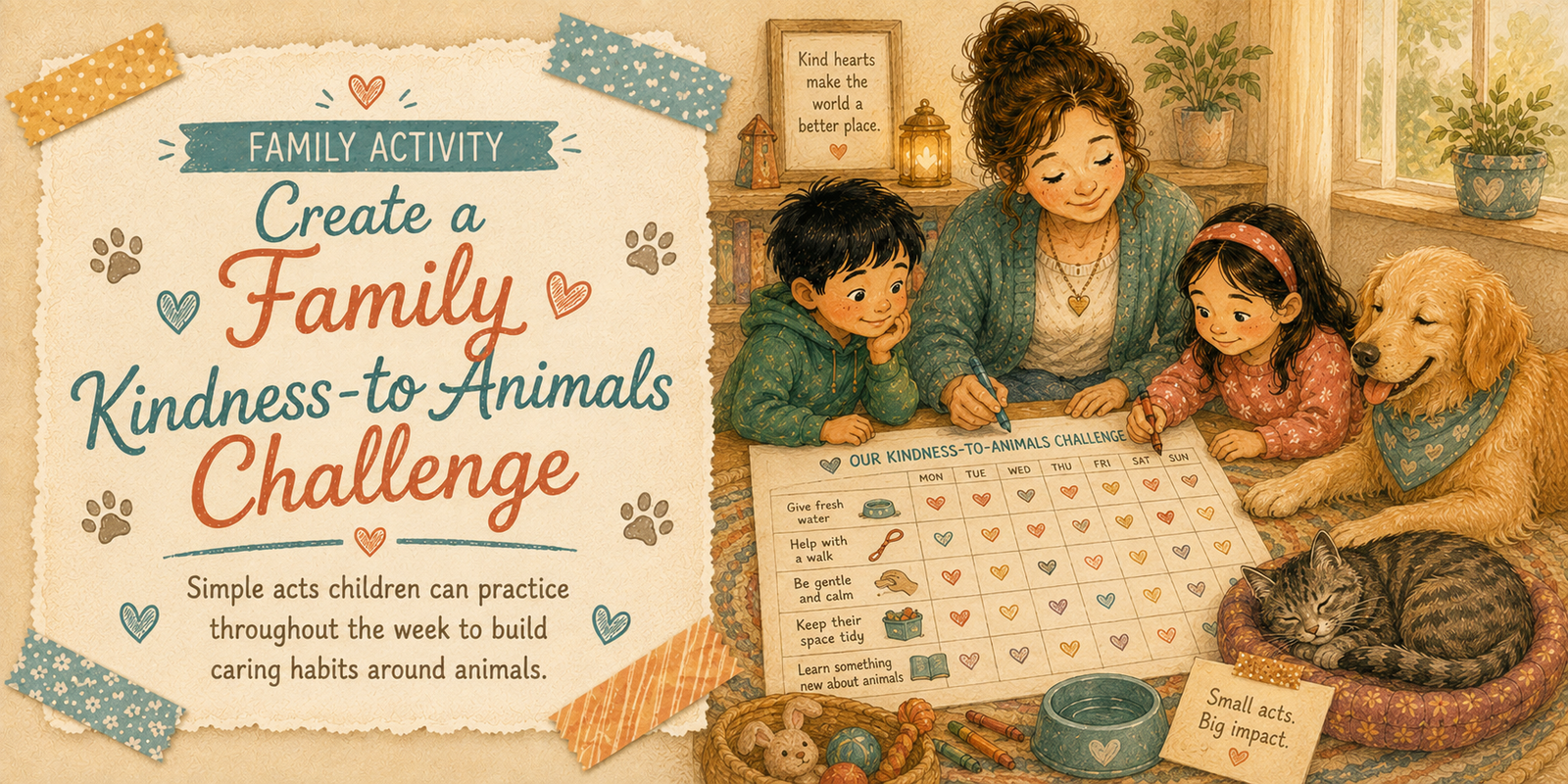
Teaching children to be kind to animals does not always need a formal lesson.
Sometimes the best practice happens in the small moments that are already part of family life.
Waiting while the dog finishes eating.
Letting the cat sleep.
Refilling a water bowl.
Watching an animal from a respectful distance.
Choosing not to follow when a pet walks away.
Those little choices add up.
A Family Kindness-to-Animals Challenge gives children a fun way to notice those moments and practice making kind choices throughout the week.
There are no points to win and no need to be perfect.
The goal is simply to practice.
How the Challenge Works
Choose seven simple kindness activities, one for each day of the week.
You can write them on slips of paper, put them on the refrigerator, make a little checklist, or let children decorate a family kindness chart.
Each day, choose one activity and look for a chance to practice it.
Some activities work best with a family pet. Others can be practiced with animals you see outdoors or with books and pretend play.
Adults should always supervise children around animals and decide which activities are appropriate for their family.
Here is an easy seven-day challenge to get started.
Day 1: Let a Resting Animal Rest
Today’s challenge is simple:
Notice when an animal is resting and leave him alone.
If your dog is asleep on his bed, let him sleep.
If the cat is curled up in her favorite chair, admire her from across the room.
If a pet has chosen a quiet corner, let that space stay quiet.
You might tell your child:
“We can show kindness by letting him rest.”
This helps children learn that loving an animal does not mean touching him every time they see him.
Sometimes kindness is simply leaving an animal comfortable.
Day 2: Fill the Water Bowl
Children often enjoy having a real job to do.
With adult help, let your child check the pet’s water bowl and help make sure clean water is available.
Talk about why animals need fresh water just like people do.
You might say:
“Taking care of animals means noticing what they need, not only what we want to do with them.”
For very young children, the adult can carry and fill the bowl while the child helps check whether it needs attention.
The point is not the chore itself.
It is learning to think about the animal’s needs.
Day 3: Practice “Let Them Come to You”
Choose a calm moment and practice waiting.
Instead of calling the pet over repeatedly or going straight to him, sit nearby and give him the choice to approach.
If he comes closer, wonderful.
If he stays where he is, that is fine too.
You can make this into a little observation game:
“Let’s see what he chooses.”
Children may be surprised by how often animals approach when they are given a little time and space.
This activity teaches patience and helps children understand that animals can make choices of their own.
Day 4: Be an Animal-Space Detective
Today, look around the house together and find the places your pet likes to rest.
Maybe it is:
- a dog bed
- a blanket beside the sofa
- a crate
- a favorite chair
- a sunny patch of floor
- a quiet corner
- a cat tree or perch
Ask your child:
“Which places seem to help her feel comfortable?”
Then decide together which areas should be treated as quiet spaces.
You could even make a small family rule:
“When she goes here, we give her some room.”
Children often understand boundaries better when they can see exactly where they apply.
Day 5: Notice Before You Touch
Before anyone pets the family animal today, practice a short pause.
Ask:
“What is he doing right now?”
Is he sleeping?
Eating?
Chewing?
Walking away?
Coming toward you?
Standing comfortably nearby?
The child does not need to analyze every movement.
We simply want to build the habit of looking before reaching.
If the moment seems appropriate for gentle interaction, an adult can guide the child.
If not, choose another activity.
That tiny pause can become one of the most useful habits a child learns around animals.
Day 6: Do One Helpful Job
Choose one age-appropriate way to help care for an animal.
Ideas might include:
- carrying clean pet blankets
- putting toys back in a basket
- helping prepare a resting area
- checking the water bowl
- bringing an adult the pet’s brush
- helping gather supplies
- drawing a picture for the pet’s space
Keep the job simple and safe.
Children do not need to be responsible for feeding, walking, grooming, or handling an animal on their own.
The lesson is:
“Animals depend on people to care for them.”
Kindness includes responsibility.
Day 7: Let an Animal Walk Away
This may be one of the most important challenges of the week.
If your pet walks away during an interaction, let him go.
Do not call him back.
Do not follow him.
Do not block his path.
Instead, say:
“He walked away, so we’re going to give him some space.”
Then wait and see what he chooses next.
Maybe he comes back later.
Maybe he goes to sleep.
Either choice is okay.
Children learn that an animal does not have to stay simply because we want the interaction to continue.
Add a Kindness Jar
If your family enjoys the challenge, make a Kindness Jar.
Write simple animal-kindness ideas on little pieces of paper and let a child choose one each day or each weekend.
Ideas could include:
- Let a sleeping pet rest.
- Check the water bowl.
- Sit quietly near your pet.
- Notice when your pet walks away.
- Help put pet toys away.
- Give your pet room to move.
- Watch birds without chasing them.
- Read a book about an animal.
- Draw a picture of something an animal needs.
- Thank someone who helps animals.
- Pick up litter where animals might walk.
- Help prepare a cozy resting place.
You can add new ideas as children think of them.
What If You Don’t Have a Pet?
You can still do a kindness challenge.
Children can practice respectful behavior around wildlife and animals they see in the community.
For example:
Watch a bird without chasing it.
Observe a squirrel from a distance.
Talk about why we should not touch unfamiliar animals.
Pick up litter with an adult so it does not become a hazard for wildlife.
Read books about animal care.
Draw pictures showing what different animals need.
Talk about how to ask an adult before approaching someone else’s pet.
Kindness toward animals is not limited to the animals who live in our homes.
Don’t Turn It Into a Competition
It may be tempting to give points or prizes for completing the most activities.
I would keep this challenge a little different.
We do not want children thinking:
“I was kind because I wanted a sticker.”
Instead, notice the choice itself.
You might say:
“You saw that he was sleeping and decided not to wake him. That was thoughtful.”
Or:
“You really wanted to follow her, but you remembered to let her walk away.”
Specific encouragement helps children understand what made the action kind.
What If a Child Forgets?
They will.
Children are learning.
A child may rush toward the dog after practicing patience all week.
They may forget and reach toward a sleeping cat.
They may become excited and need a reminder.
That does not mean the challenge failed.
Simply help them try again.
“Remember our kindness challenge. What could we do instead?”
Practice works because children get another chance.
And another.
And another.
Finish the Week With a Family Conversation
At the end of the challenge, sit together for a few minutes and talk about what everyone noticed.
Ask simple questions:
Which kindness activity was easiest?
Which one was hardest?
Did you notice something our pet likes?
Did you notice something our pet does when he wants space?
What kindness idea should we keep doing next week?
Children may notice things adults did not expect.
That is part of the fun.
A Week of Small Choices
The Family Kindness-to-Animals Challenge is not about completing seven perfect tasks.
It is about helping children practice a way of thinking:
What does the animal need right now?
Over time, those tiny pauses and choices can become habits.
A child learns to notice.
To wait.
To give space.
To help.
To let an animal choose.
And little by little, kindness becomes something they do naturally.
Pause. Notice. Choose kindness. ♥ 🐾
