
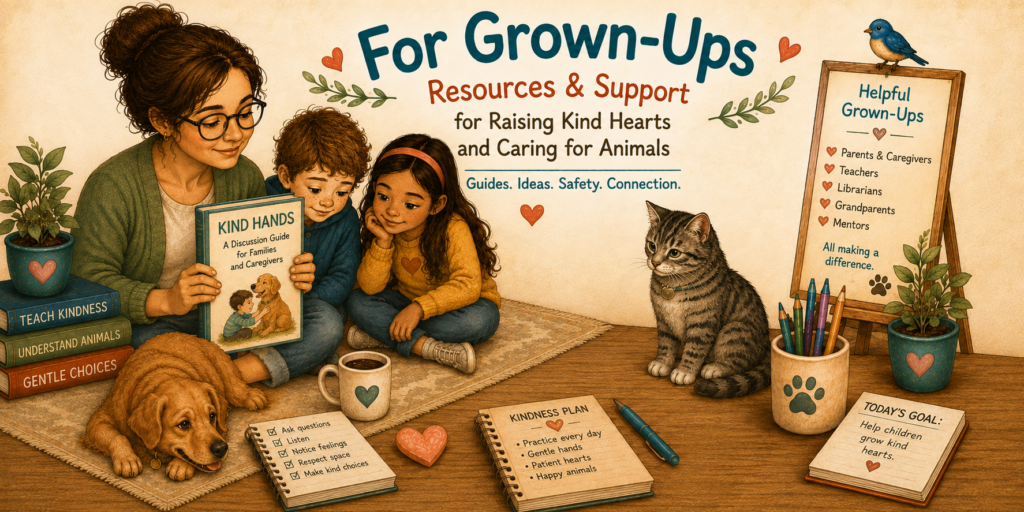
For Grown-Ups
This space is for parents, grandparents, caregivers, teachers,
librarians, and other adults who want to help children understand
animals better. You’ll find ideas for talking about kindness,
questions to ask while reading, safety reminders, discussion guides,
and simple ways to carry the lessons in our books into everyday life.
♥
Resources for the Grown-Ups Who Guide Them
Children’s books can open the door to conversations that continue
long after the last page is turned.
Discussion Guides
Questions and conversation starters that help children think
about an animal’s feelings, needs, choices, and boundaries.
Animal Safety Notes
Gentle reminders for helping children learn safe and respectful
behavior around pets and other animals.
Kindness at Home
Small ways families can practice patience, gentle hands,
responsible care, and respect for animals every day.
Teacher Resources
Ideas for classrooms, libraries, child-care settings,
story time, group discussions, and kindness activities.
How to Use Our Books With Children
You don’t need a formal lesson plan. A few thoughtful questions and
everyday conversations can help a story become something a child
remembers and uses in real life.
Before You Read
Look at the cover together. Ask what the child notices about
the people and animals. Talk briefly about what kindness to
animals might look like.
Pause During the Story
Ask what the animal might be feeling. Notice body language,
space, gentle choices, and moments when a character stops
to think before acting.
Talk Afterward
Connect the story to the child’s own experiences. Ask what
they might do the next time a pet walks away, needs quiet,
feels nervous, or wants space.
Questions to Ask After Reading
There are no perfect answers. These questions are simply ways to
help children notice, think, and talk about the choices in a story.
What did you notice that gave you that idea?
What might an animal do when it wants more space?
Was there another kind choice the character could have made?
Can you show me what gentle hands look like?
How can we show respect when an animal does not want attention?
Think about food, water, rest, play, shelter, patience, and quiet time.
If you saw another child bothering an animal, how could you help safely?
Kindness Includes Safety
Being kind to animals also means learning how to interact with
them safely. Every animal is different, and even a familiar pet
may need space sometimes.
Adult Supervision Matters
Young children should be supervised around animals.
An adult can help both the child and the animal feel safe.
Let Animals Walk Away
Children can learn that following, cornering, grabbing,
climbing on, or blocking an animal is not kind.
Ask Before Touching
Children should ask the responsible adult before approaching
or touching an unfamiliar animal.
Respect Eating and Sleeping
Animals should be allowed to eat, sleep, rest, and enjoy
special treats without being bothered by children.
Watch the Animal’s Body Language
Turning away, hiding, becoming still, moving away, growling,
hissing, or trying to escape can all mean the animal needs space.
Never Punish a Warning
A growl, hiss, or attempt to move away is information.
Move the child away calmly and give the animal space.
educational information for families and educators. Our resources are
not a substitute for advice from a veterinarian, qualified animal
behavior professional, medical professional, or other appropriate
professional when individual safety concerns exist.
Made for All the Grown-Ups in a Child’s World
The same story can become a different kind of teaching moment
depending on where and how it is shared.
Parents & Caregivers
Use the books during bedtime, quiet time, after a difficult
moment with a pet, or whenever a child has questions about
how animals feel and communicate.
Teachers & Child-Care Providers
Use stories as a starting point for group conversations,
kindness themes, drawing activities, role-playing, and
classroom discussions about gentle choices.
Librarians & Community Groups
Pair a story with animal-themed crafts, kindness pledges,
coloring sheets, humane-education discussions, or a
family story-time activity.
Grown-Up Guides Are Coming
As our books are released, we’ll add free companion resources to
help adults continue the conversations at home, at school, and
during story time.
FREE RESOURCES COMING SOON ♥
Visit Kindness Corner
Find articles for parents, caregivers, and teachers about
kindness to animals, children’s activities, book news,
and seasonal ideas.
Free Printables for Kids
Pair your conversations with coloring pages, gentle-hands
activities, kindness worksheets, puzzles, and other
child-friendly resources.
Stay in the Kind Hands Loop
Get new grown-up resources, free printable announcements,
Kindness Corner articles, book news, and activity ideas
delivered to your inbox.
EMAIL SIGNUP FORM GOES HERE
Replace this box with your newsletter signup form.
Please do not submit a child’s personal information.
Unsubscribe anytime.
Children learn kindness one small moment at a time.
Thank you for helping them learn to listen, notice,
care, and choose gentle hands.